Designing High-Impact Learning Experiences in a BSN Program
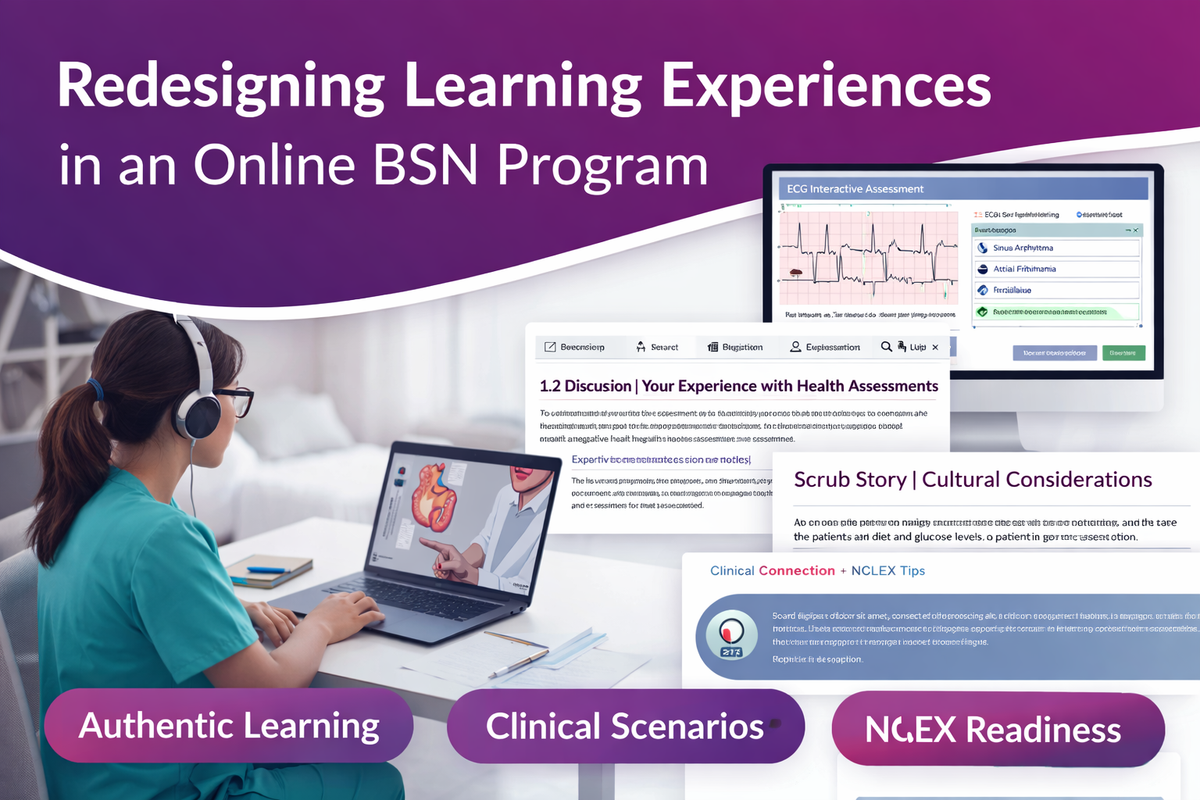
Redesigning learning experiences across a fully online BSN program to improve engagement, clinical reasoning, and NCLEX readiness through authentic, aligned, and application-driven instruction.
Context
- Fully online BSN program preparing students for licensure
- Developed 5 courses and served as program lead, overseeing ~12 additional courses
- Courses relied heavily on publisher content (ATI), with limited faculty interaction
- Accrediting bodies and nursing boards flagged:Overreliance on external toolsPoor alignment to learning outcomesWeak preparation for NCLEX
The Problem
- Courses functioned as content delivery, not learning experiences
- Heavy reading load with little connection to clinical practice
- Assessments and rubrics misaligned with learning objectives
- Minimal opportunities for clinical reasoning, application, feedback and iteration
- Low NCLEX performance and inconsistent student engagement
Design Principles
To redesign the program, I established a set of guiding principles:
- Application over exposure: Students must use knowledge, not just read it
- Clinical realism: Learning should mirror real nursing decision-making
- Alignment-first design: Objectives → instruction → assessment must match
- Scaffolded practice: Low-stakes → feedback → high-stakes performance
- Relevance and empathy: Connect learning to students’ lived experiences and future roles
Key Learning Experience Innovations
1. Structured Learning Flow: Learn → Practice → Apply
I redesigned all courses around a consistent progression:
- Lesson/Reading → foundational knowledge
- Practice → low/no-stakes skill development with feedback
- Apply → high-stakes, real-world performance
This ensured students were prepared—not surprised—by assessments.
2. Pre/Post-Knowledge Activation (Metacognitive Learning)
Students engaged in structured reflection before and after learning.
Example artifact: "What Do You Know About Health Assessments?"
Students first documented their baseline understanding After learning, they revised their thinking using new knowledge This reinforced conceptual understanding, self-awareness and knowledge transfer.
3. Case-Based, Personally Relevant Learning
I designed activities that connect learning directly to lived experience.
Example: Students reflected on a real health assessment experience, then applied new knowledge to analyze and improve it. This exercise reinforced clinical reasoning, empathy for patients and immediate relevance to students' lives.
4. Authentic, Scaffolded Skill Development
Students practiced clinical skills in stages:
- Practice (low-stakes): Record and submit patient assessments with instructor feedback.
- Apply (high-stakes): Perform live clinical assessments and complete EHR documentation.
This created a true learning loop: attempt → feedback → improvement → performance.
5. Objective-Aligned Rubric Design
I eliminated subjective grading and aligned all rubrics directly to learning objectives.
Example artifact: Module 4 Rubrics
Each rubric criterion mapped to a specific learning outcome. I removed irrelevant criteria (e.g., grammar, creativity). I ensured students were evaluated on clinical competence—not formatting or technology skills.
6. "Scrub Stories" (Narrative-Based Learning)
I introduced faculty-written, real-world narratives. These were anonymous clinical stories from actual nursing faculty that contextualized course concepts in real practice and encouraged reflection and discussion.
Example: A case exploring cultural considerations in diabetes management, prompting students to balance clinical guidelines with patient values.
7. Gamification and Clinical Decision-Making
I developed interactive learning experiences such as escape rooms requiring prioritization across multiple patients and scenario-based challenges mirroring real clinical environments. Students reported high engagement and demonstrated strong performance in these activities.
8. Embedded NCLEX Preparation
I integrated continuous, low-stakes NCLEX practice by using “Clinical Connection” and “NCLEX Tip” callouts, frequent, chunked NCLEX-style questions and by providing immediate feedback via interactive elements. This normalized NCLEX thinking as part of everyday learning rather than a separate activity.
9. Interactive Media and Simulation
I partnered with media teams to build advanced interactives such as an ECG interpretation tools with instant feedback, scenario-based decision-making exercises, and embedded simulations aligned to course outcomes.
10. Reduced Over-reliance on Publisher Content
As program lead, I limited ATI use to 1–2 activities per module and repositioned it as a supplement rather than the core learning experience. I re-centered courses around faculty-driven learning design.
Impact
Student Experience Impact
- 90%+ student satisfaction across redesigned courses
- High engagement with interactive and applied learning activities
- Strong qualitative feedback, especially on:
- Escape rooms
- Case-based learning
- Narrative elements
Learning and Performance Impact
- Improved clinical reasoning and application skills
- Increased performance in high-risk courses (e.g., A&P, fundamentals)
- Improved NCLEX preparation through integrated practice
Program Impact
- Improved NCLEX scores
- Strong faculty satisfaction and increased demand for collaboration
- Established a consistent, scalable learning experience model across the program
Tools & Capabilities Demonstrated
- Learning experience design
- Authentic assessment design
- Clinical education strategy
- Alignment-driven instructional design
- Gamification and interactive learning
- Program-level design leadership