Assessment System Redesign
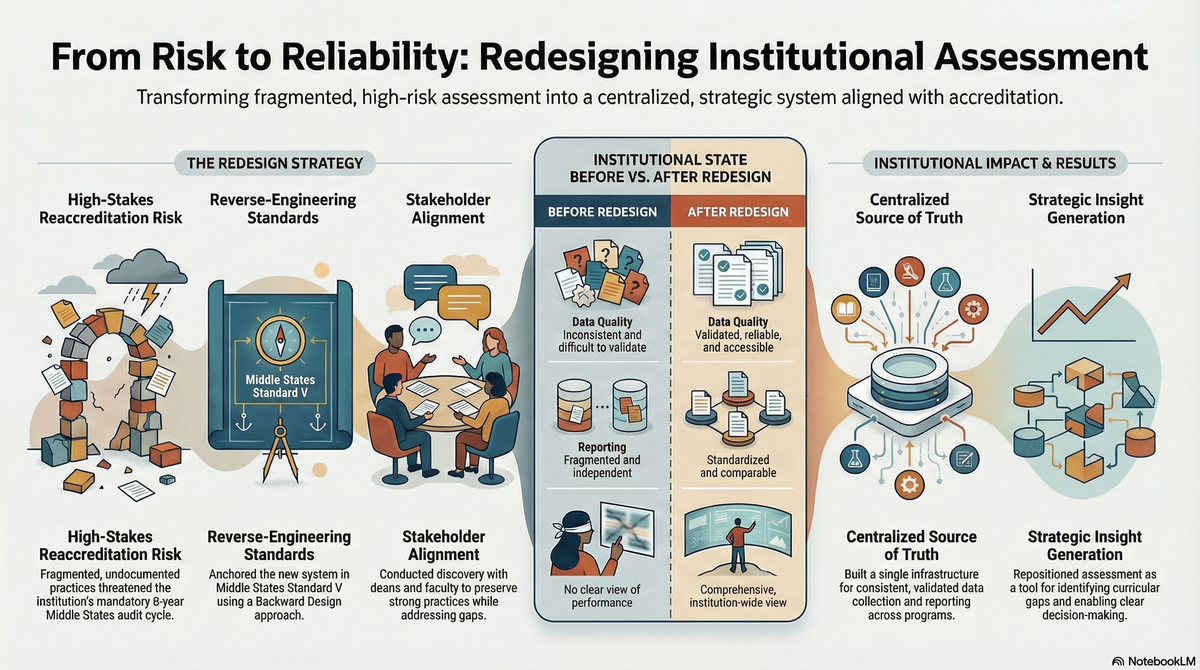
Building a scalable, institution-wide reporting infrastructure for an institution at risk of reaccreditation failure due to fragmented, non-standardized assessment practices
Context
- Institution approaching Middle States Commission of Higher Education reaccreditation review (8-year cycle, high stakes)
- Required onsite evaluation and full audit of assessment reporting
- Assessment practices were inconsistent, fragmented, and sometimes undocumented
- No centralized system for collecting, analyzing, or reporting outcomes
- Urgent need for a scalable, accreditation-aligned assessment infrastructure
The Problem
- Departments operated independently; no standardized assessment practices
- Data existed, but was inconsistent, inaccessible and difficult to validate
- Reporting lacked structure, comparability and reliability
- Leadership had no clear, institution-wide view of performance or outcomes
- Institution faced significant risk to accreditation status
My Role
As Associate Vice President for Teaching and Learning, I partnered directly with deans, department chairs, and program leads, reporting to the Chief Academic Officer. I led the design and implementation of a system that would:
- Standardize assessment practices across programs
- Enable consistent, validated data collection and reporting
- Align outputs with accreditation requirements
- Scale sustainably across departments
Approach
1. Stakeholder Discovery and Alignment
Before designing the system, I conducted structured conversations with deans, chairs and faculty to understand existing practices. I wanted to know what was working well, where challenges existed and what felt burdensome or ineffective. This ensured the new system preserved strong practices while addressing gaps and increasing adoption.
2. Reverse-Engineering Accreditation Requirements
I analyzed Middle States Standard V to define required data points, reporting structures and compliance expectations. Using Backward Design, I anchored the system to accreditation requirements from the outset rather than retrofitting later.
3. Auditing Existing Practices
I reviewed historical reports and data sources across programs, mapping inconsistencies, gaps and redundancies. This process confirmed that while meaningful assessment work existed, it was limited by lack of standardization, aggregation, and usability at scale.
4. Designing the System
I built a centralized infrastructure including standardized data collection templates, clear reporting guidelines aligned to accreditation language and a structured institutional timeline for submission, review and revision. A centralized document management system served as a single source of truth, improving accessibility, version control and cross-program comparison.
5. Implementation and Adoption
I partnered with academic leaders to pilot and refine the system, providing guidance and iterative feedback during data collection. I then consolidated program-level data into school- and institution-level reporting.
6. Institutional Reporting and Insight Generation
With the system in place, I synthesized data across programs to identify trends, gaps and opportunities. By cross-referencing outcomes, demographics and survey data, I developed a comprehensive institutional assessment report aligned to Middle States standards, enabling clearer decision-making and continuous improvement.
Impact
Institutional Impact
Established the first centralized assessment system, enabling consistent, comparable reporting across all programs and improving readiness for accreditation and programmatic review.
Operational Impact
Reduced ambiguity for academic leaders, streamlined data collection and reporting, and significantly improved data accuracy and completeness.
Strategic Impact
Provided leadership with a clear, institution-wide view of program effectiveness, identified gaps in curriculum and outcomes and repositioned assessment from a compliance task to a strategic improvement tool.
Tools & Capabilities Demonstrated
- Systems design & operational strategy
- Accreditation alignment
- Data analysis & synthesis
- Cross-functional leadership
- Change management