Library Strategic Plan Redesign
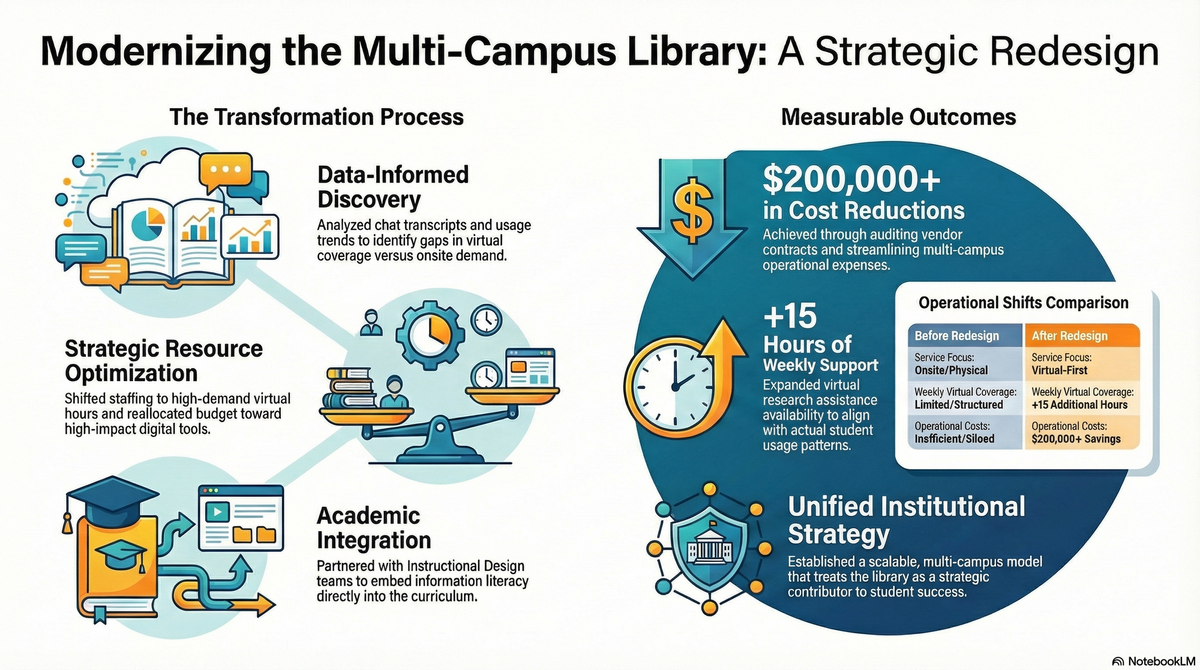
Building a multi-campus library strategy that optimized staffing, reduced costs and redesigned services to better meet evolving student and institutional needs.
Context
- Four campus libraries and virtual services operating with limited staffing
- Two full-time librarians supporting all in-person and virtual demand
- Increasing reliance on virtual research support and chat-based services
- Physical spaces underutilized and inconsistently leveraged across campuses
- Budget constraints requiring cost reduction without diminishing service quality
- Need to better integrate library services with academic programs and student support
The Problem
- Staffing model misaligned with actual student usage patterns
- High demand for virtual support with limited structured coverage
- Physical library spaces not optimized for current student needs
- Budget inefficiencies across vendor contracts and operations
- Library operated as a standalone service rather than an integrated academic partner
My Role
As Associate Vice President for Teaching and Learning, I partnered with the Sr. Director of Library and institutional leadership to design and implement a strategic plan that would:
- Optimize staffing across physical and virtual environments
- Improve budget efficiency and reallocate resources strategically
- Redesign service delivery to align with student behavior and demand
- Reposition the library as an integrated partner in teaching and learning
- Establish a scalable model adaptable to future growth and change
Approach
1. Stakeholder Discovery and Alignment
My first priority was to engage academic leadership, library staff and student support teams to identify service gaps, constraints and priorities. I gathered qualitative feedback on staffing challenges, service delivery and integration with academic programs.
2. Data Collection, Analysis and Reporting
I led a multi-source analysis of library usage trends (onsite vs. virtual), chat support volume, timing and demand patterns, research request data and class support usage. We analyzed chat transcripts to identify recurring student challenges and high-friction assignments and evaluated how and when students accessed services, which illuminated gaps in coverage.
The data showed that students consistently preferred virtual chat support over onsite assistance. Demand remained steady through the week, with notable gaps during service closures. Physical library usage was primarily functional (printing, computers, quiet study) rather than research-driven or focused on academic support services. A small number of courses and faculty drove the majority of in-class support demand.
3. Auditing Staffing, Budget and Resource Allocation
The Sr. Director of Library and I reviewed staffing coverage against actual demand patterns. We evaluated vendor contracts and operational expenses, and we identified misalignment between resource allocation and student behavior.
4. Designing the Strategic Plan
I developed a multi-campus strategy focused on:
- Virtual-first service delivery
- Optimized staffing models
- Budget reallocation and cost savings
- Reimagined use of physical space
- Increased integration with teaching and learning
5. Implementation and Operational Shifts
I shifted staffing to prioritize high-demand virtual support hours. I leveraged part-time and student workers for onsite coverage and expanded service availability to better align with student usage patterns. I also reallocated budget toward higher-impact tools and services.
6. Integration with Academic and Student Support Services
The strategic plan strengthened collaboration between the Library, Instructional Design and Student Support teams. It increased proactive outreach to faculty for course support and resource integration, and it positioned the library as a partner in information literacy and curriculum design.
Impact
Institutional Impact
- Established a unified, multi-campus strategy for library operations
- Strengthened alignment between library services and academic priorities
- Positioned the library as a strategic contributor to student success
Operational Impact
- Realigned staffing to better support high-demand virtual services
- Expanded virtual support coverage by ~15 hours per week
- Reduced vendor and operational costs by $200,000+
- Improved efficiency of limited staffing resources across campuses
Student Experience Impact
- Expanded access to timely research and academic support
- Increased utilization of both virtual and physical library services
- Improved functionality and engagement within library spaces
Tools & Capabilities Demonstrated
- Strategic planning & systems design
- Resource and budget optimization
- Service design & user experience
- Cross-functional leadership
- Data-informed decision-making