Weekly Cross-Functional Leadership Model (SFS Meetings)
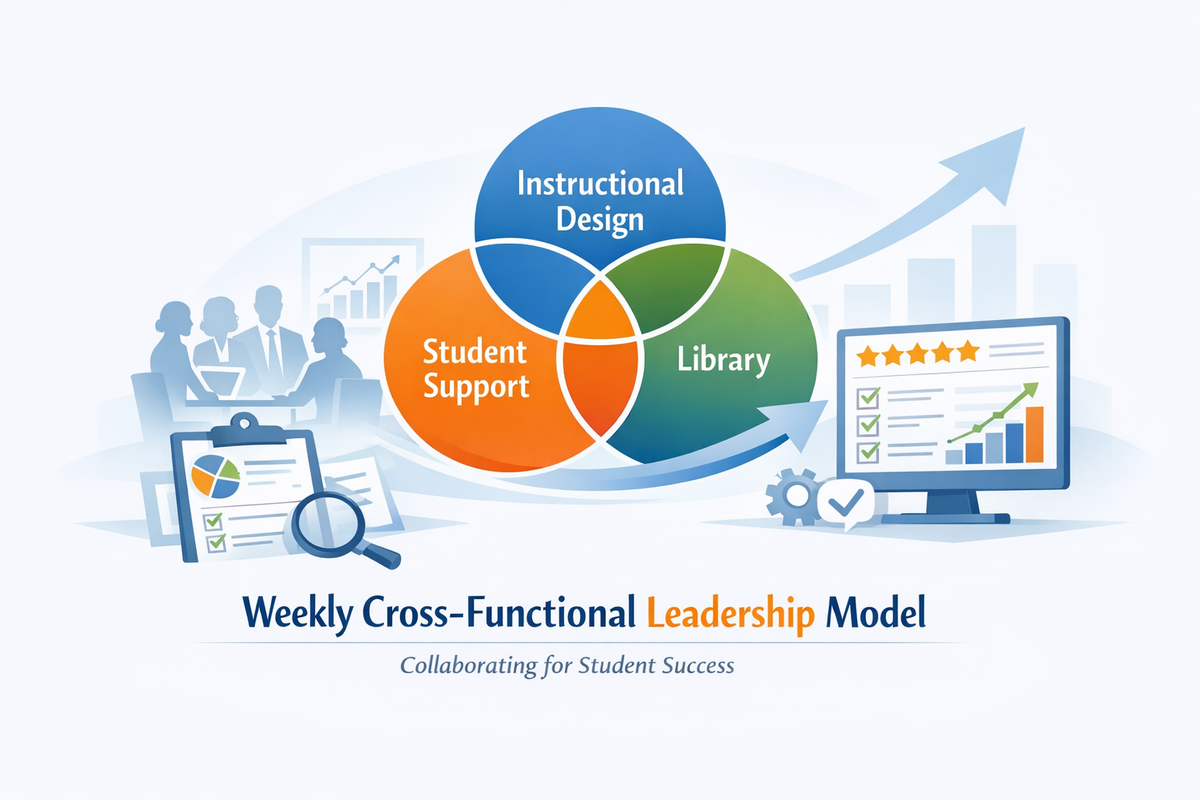
Establishing a standing cross-functional leadership model that aligned instructional design, student support and library services to identify and resolve high-impact learning challenges.
Context
- Academic support functions operated largely in silos:
- Instructional Design / Faculty Development (faculty-facing)
- Student Support Services (student-facing)
- Library (faculty and student-facing)
- Limited coordination across teams addressing the same student challenges
- Persistent issues in key courses with low performance and high support needs
- Lack of a structured mechanism to connect:
- Student experience data
- Instructional design decisions
- Resource effectiveness
The Problem
- Teams worked independently on overlapping issues
- No shared process for identifying or prioritizing high-impact course challenges
- Limited visibility into why students were struggling
- Course improvements were reactive and inconsistent
- Leadership lacked a coordinated, data-informed intervention model
My Role
As Associate Vice President for Teaching and Learning, I designed and facilitated a weekly cross-functional leadership model that would:
- Align instructional design, student support and library teams around shared goals
- Integrate qualitative and quantitative data into decision-making
- Identify high-impact course issues and prioritize interventions
- Drive coordinated action across faculty-facing and student-facing teams
- Establish a repeatable model for continuous course improvement
Approach
1. Establishing the Cross-Functional Model
I created a standing, weekly leadership meeting (Student-Faculty Support Services, or SFS) with my senior directors from instructional design/faculty development, student support services and the library. I led structured meetings around shared data, priorities and action items and established a consistent cadence for collaboration and follow-up.
2. Data Integration and Analysis
One example of how this model operated: we analyzed D/F/W rates (Ds, Fs, Withdrawals) across courses on a semesterly basis in order to identify the 10 highest-risk courses based on student performance. I led my teams in conducting a deeper analysis to pinpoint specific assignments and assessments driving failure and to determine which learning outcomes were not being met.
3. Multi-Perspective Insight Gathering
Each team contributed unique, complementary insights. Instructional design/faculty development identified gaps in instructional strategies and assessment design and partnered with faculty to redesign problematic course components.
Student support services provided data on student help-seeking behavior and identified specific assignments and concepts students struggled with, along with qualitative insights from tutoring and support interactions.
The library evaluated the effectiveness of readings, resources and vendor materials used in the courses. They also identified gaps in research support and resource alignment and collaborated with faculty to improve instructional materials.
4. Targeted Intervention Design
I developed coordinated plans to revise high-impact courses and proposed instructional improvements such as more effective assessment strategies (e.g. two-way rubrics), improved alignment between learning objectives, instruction and assessment, and enhanced integration of library resources and research support.
5. Leadership Alignment and Execution
I presented findings and a prioritized course list to the Provost Advisory Group and partnered with deans, department chairs and faculty champions to coordinate implementation of the targeted course revisions.
6. Continuous Feedback and Validation
I monitored post-revision outcomes through student support request data, library usage and feedback, final grades and faculty surveys. This data validated the effectiveness of changes through reduced student struggles and support needs.
Impact
Institutional Impact
- Established a repeatable, cross-functional model for course improvement
- Strengthened alignment across academic and support functions
- Improved institutional ability to respond to student performance data
Operational Impact
- Broke down silos between instructional, academic support and resource teams
- Created a structured, data-driven decision-making process
- Enabled faster, more coordinated interventions across courses
- Reduced support request volume, easing workload for understaffed student support and library teams
Student Outcome Impact
- Reduced D/F/W rates in targeted high-risk courses
- Decreased student support requests related to revised courses
- Improved alignment between course design and student needs
Tools & Capabilities Demonstrated
- Cross-functional leadership and facilitation
- Data-driven decision-making (D/F/W analysis)
- Systems thinking and process design
- Instructional improvement strategy
- Stakeholder alignment and execution